Céline Vahsen
ABOUT THE ARTIST
Growing up in the German-speaking region of Belgium, the border area between Belgium and Germany has fundamentally shaped the Céline Vahsen’s identity and practice. A recent solo exhibition, Shiftings, at IKOB in Eupen marked an intense encounter with a familiar yet transformed territory, deepening an engagement with multilingual identity, belonging, and memory. The Rhineland represents the origin of their connection to contemporary art, sparked by early visits to IKOB and the Ludwig Forum in Aachen. Returning to this cultural landscape for the Borderland Residency at the Ludwig Forum marks a meaningful continuation of this trajectory. Residencies form an essential part of Vahsen’s methodology, offering a productive space of uncertainty to challenge established frameworks and expand institutional networks.
ARTISTIC METHOD
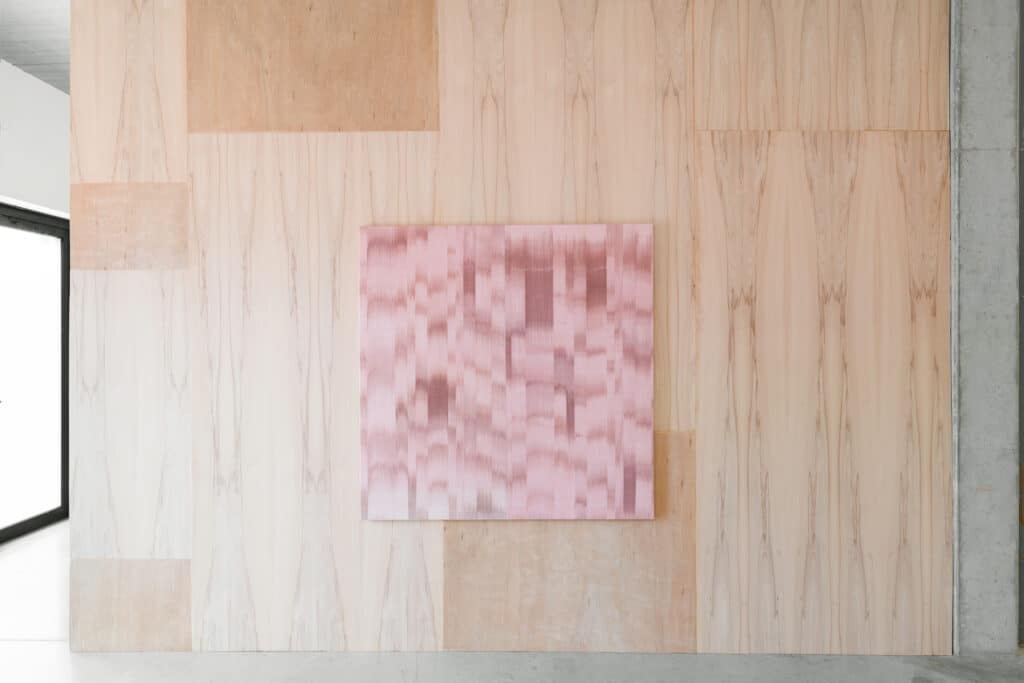
Céline Vahsen’s practice originates in the heritage of textiles, employing traditional methods such as natural dyeing and manual weaving to translate hybrid cultural traditions into contemporary conceptual frameworks. Focusing on memory, territory, and environmental transformation, the works carry narratives within their fabric, exploring transition, adaptation, and a continuous dialogue with time. Rejecting industrialized speed, the work embraces slow, intimate rhythms of production. The inherent fragility of natural dyes—which evolve over time on canvas—functions as a quiet aesthetic of resilience rather than a defect to control. Beyond historical reconstruction, the practice critically examines ecological footprints and investigates what the shift from craft to industrial mass production reveals about the contemporary condition
PROJECT DURING BORDERLAND RESIDENCIES
Using the historical Aachener Tuch as a conceptual reference point, the project explores transformation, human labor, and deceleration in contrast to modern industrialization and AI-driven acceleration. Instead of digital rendering, Céline Vahsen will create a new series of works on existing fabric, using hand-stitched line patterns to structure natural dyeing processes and leave physical traces of labor. This process-oriented research turns textile production into an act of resistance, care, and embodied knowledge. Based in the Ludwig Forum atelier, the project adopts an open-ended methodology to experiment with local plant dyes, archive material histories, and reflect on value, resources, and local identity within the Euregio landscape.