Mariam Akubardia
ABOUT THE ARTIST
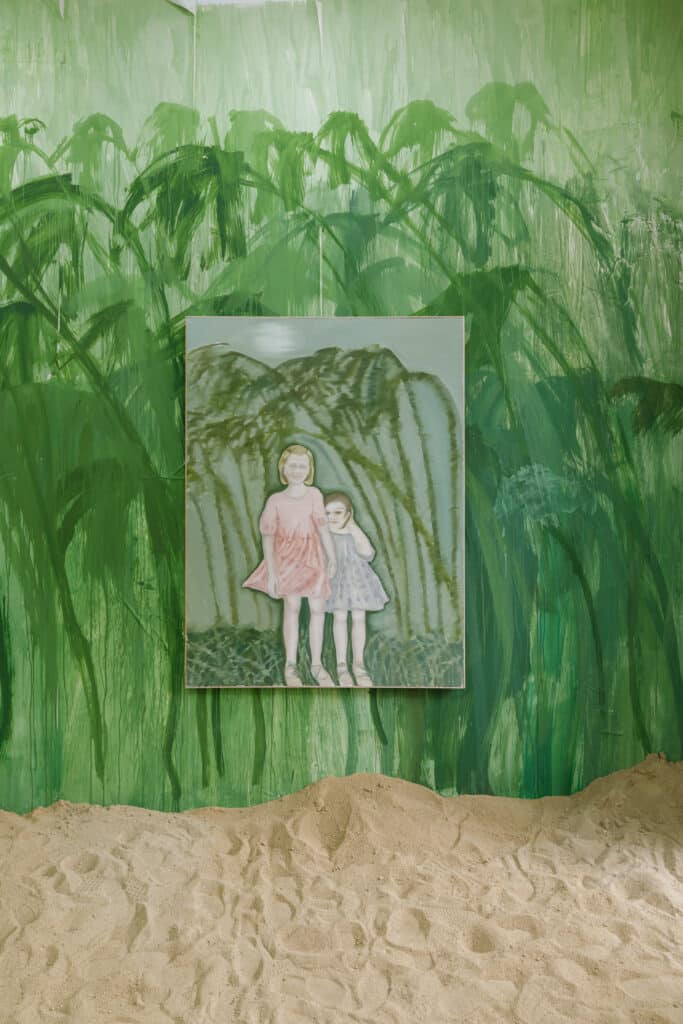
Mariam Akubardia (b. 1991, Gali, Abkhazia, Georgia) is a Georgian painter and multidisciplinary visual artist based in Tbilisi. Displaced from her home during the Abkhazian war in early childhood and later raised in occupied Gali, her practice explores memory, displacement, loss, and the persistence of belonging through painting, installation, and collaborative projects.
Rooted in personal and collective experiences of conflict, Akubardia revisits landscapes, domestic
spaces, and public buildings that exist today primarily through fragments of memory. Her paintings often depict abandoned cities, damaged kindergartens, hospitals, Soviet-era sanatoriums, and subtropical environments, where citrus trees, palms, and cacti coexist with traces of absence and survival.
Akubardia’s work has been exhibited internationally and is held in private collections across Europe and Australia. In 2019, she won the Bauhaus Women competition organized by the Heinrich Böll Foundation South Caucasus and the Bauhaus Project. In 2023, she was featured by Harper’s Bazaar Germany as one of the most important emerging artists. Her work has been discussed in the academic essay Violence of Tropicalization: On the Politics of Cold and Whiteness in the Subtropics of the Caucasus as part of a broader consideration of artistic practices engaging with tropicality, nature, and experiences of displacement.
Together with her husband, she co-authored 6200, a comic book about the lives of internally displaced people, initiated in 2020 and published by ZTSCRPT in Berlin in 2023.
PROJECT DURING BORDERLAND RESIDENCIES
„My project, The Stranger, grows out of my personal experience as a displaced person and my
ongoing search for identity and belonging.
After the war, my family and I moved between several cities. I never fully felt that I belonged to
any of them. Each new place became temporary, and with every move I felt further away from
the idea of home. I was constantly adapting to new surroundings, while at the same time losing
a clear sense of where I belonged. Over time, this experience of displacement became deeply
connected to the way I understood my own identity.
When I returned to Gali, the occupied city where I spent part of my childhood, I realised that my
connection to this place was much stronger than I had understood before. I felt a familiarity with
its landscape, climate, soil, and people that I had not found anywhere else. Yet, at the same
time, I also felt like a stranger there. I had been away for many years and had changed. I was
no longer completely part of the place I remembered, but I also did not fully belong anywhere
else.
This contradiction is at the centre of The Stranger: the experience of being a stranger in your
own country and, at the same time, carrying a deep connection to a place that is no longer fully
accessible.
During the residency, I want to explore this experience through painting and objects, together
with photographic documentation from my occupied neighbourhood in Gali. The photographs
will not be a direct documentation of war. Instead, I want to use them as fragments of a place
that remains closely connected to my memory and identity. I am interested in how a landscape,
an image, an object, or a small detail from everyday life can hold a sense of belonging.
I will use these fragments as a starting point for paintings and objects, bringing together
personal memory and the physical reality of a place. The process will be based on observation,
remembering, collecting, and experimentation. I want the work to develop through this process
rather than begin with a predetermined final form.
For me, The Stranger is not only about the loss of home. It is about what happens to identity
when home becomes distant, inaccessible, or fragmented. It asks whether a sense of belonging
can be rebuilt from the fragments that remain, and whether being a stranger can itself become
part of who we are.“